It’s ok, my bad at first for not understanding the specifics and not taking the time to actually see what you are saying. Yes, I change the custom icons myself, thanks for posting and hopefully it exists in Truenas soon. I just wanted to give you a non change Truenas option that is native docker.
What’s weird is it does work to me, but, it’s a semi well known docker workaround that has worked for many many years as docker has never responded to the github issue for your requirement (from someone else). I believe they suggested it originally.
So I’m kind of a dummy when it comes to Docker, specifically when it comes to Dockerfiles, as I’ve never had occasion to use them before. So I create $SOMEDIR, and in that create Dockerfile mostly as above (though with Cloudflare because I’m using that), compose.yaml mostly as above, and .env containing my admin email and API credentials.
Then create a custom app containing:
include:
  - $SOMEDIR/compose.yaml
Straightforward enough–but where does the custom Caddy image get built? It has to, right, to include those two plugins? Or does the (effective) docker compose up -d build that as part of the process?
Edit: Well, nothing like just giving it a try. And the answer is, yes, docker compose up does build the Dockerfile. It works, Homepage proxies behind it with just two labels (vs. five with Traefik), and of course Caddy’s configuration is considerably simpler than is Traefik’s. Now a bit of conversion to do on my apps. And work out how to expose Caddy’s API to Homepage…
I am new to TrueNAS and I am undecided between dockg and this custom app/include approach.
What I really would like is to keep the dependencies/additional tools to a minimum, so this is a plus of this approach, although realistically, I would need studio code server or similar to edit.
What i am wondering about this approach:
My understanding is that I can export a TrueNas Settings file, load that into another server and everything will be restored from there (except for the Data).
If I go for this approach and restore, would the custom docker files be part of the TrueNAS Settings file? Probably not, right?
But apart from that: What is the benefit of this approach vs. dockge?
Didn’t use dockge, so can’t say for sure. But if I were serious about running docker containers on truenas, I would deploy portainer-agent to truenas and then would manage containers from the portainer on a separate machine. Thus, truenas would store only data volumes and images.
Right now I run only 1 container on truenas, so I decided to not go the portainer-agent way. Can’t say that suggested approach is the best; I am just experienced with/used to portainer.
I confirm all of this as well. I setup my apps in TrueNAS this way last night.
I like having all of my containers setup with compose so that I can use git to backup the compose.yaml, any .env files, and any other config files. It helps me track what changes I’ve made to a stack in time. It’s come in handy more times than I can count to see “updated config due to v1.2.3 breaking change”. Or else I might fix the same thing multiple times.
It seems you can’t control the stack via CLI once it’s added in the GUI. When I ran ‘docker compose ps’ in the stack directory, no containers were listed.
Just an FYI if your intention was to gain some visibility in the GUI but continue managing via CLI. I could also be wrong - I only noticed this when I went to down the test stack I had added using the includes option and did not test thoroughly.
If you want to use the docker compose command to aid you in some tasks:
First check list of projects with docker compose ls. It will print out a table of NAME, STATUS, CONFIG FILES. The names are in format of ix-<HowYouNamedYourAppInUI>
Now run a command like docker compose -p ix-minio ps
Tada . Very neat. You can use it for some things if you can’t be bothered to do them in the UI or factually can’t do them there, and it’s cleaner than messing up with the containers individually. As for why you can’t instead enter the workdir of Compose project like usually with stacks or use the -f option to specify the runtime path of Compose file: don’t ask me.
But actually some rare things might want -f to the Compose file and you can also run docker compose pull in the directory without any further options, which also doubles as a way to validate your Compose file contents.
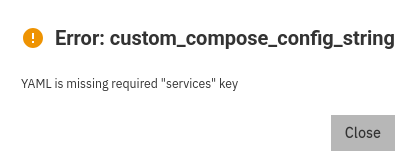
But the reason I’m coming back to this thread is to report that TrueNAS 25.10 partially breaks this now:
In case anyone wanted to know how to add a button that links to the application (and/or add some notes to this application in TrueNAS):
If you install a new yaml using this Custom Config, you can add the following snippet and customize to your needs to show a button to your application. This only appears to work at the time of creating the app. Adding OR changing the extra stuff after the fact did not add, or change, the button or Notes. You’ll have to recreate the application if you made a mistake.
include: - path: /mnt/<path/to/compose.yaml services: {} x-notes: | # VS Code Server or whatever Add as many lines of text as you want, but do mind the indentation x-portals: - host: 0.0.0.0 # replace this with FQDN or dedicated IP address if you like name: Web UI # text on the button path: / port: 8880 # change to whatever port the service is listening on scheme: http # change to https if the app uses HTTPS
Since this topic is kind of Caddy central… This topic (Shortlived certificates (from Let's Encrypt) - General - Caddy Community) in the Caddy forum describes how to use the shortlived certificates from Let’s Encrypt, if desired. To do this using labels in the Compose file, set the following caddy_2 labels:
Hi everyone, has anyone found a solution for git synchronization with TrueNAS applications?
I recently switched from a simple Debian Docker setup with Portainer to TrueNAS, and I’m looking to replicate my workflow. Ideally, I’d like to use a single Git repository with periodic git fetch updates alongside my Renovate bot for automated versioning, this could potentially eliminate my need for Portainer altogether.
Does anyone have experience with this approach? What would be the best and cleanest way to manage a Docker stack on TrueNAS currently?
Hi, thanks for the answer! Nothing wrong with Portainer per se, but I have a few specific pain points that pushed me to look for alternatives:
Git credentials per stack : When my GitHub token expires, I have to reset it in every single stack individually. It gets old fast.
No TrueNAS GUI integration : Portainer-managed containers don’t show up in the TrueNAS Apps screen, so I’m juggling two interfaces. There are feature requests for this (here and there) but nothing shipped yet.
Clunky local editing workflow : Right now, testing a config change means: create a dev branch, switch to it in Portainer, test, merge to main, switch back. I’d rather just edit the compose file directly via SSH/VSCode, verify it works, then commit. Much simpler.
Backup integration : Managing everything through TrueNAS natively should make replication and snapshots more straightforward, though I’ll admit I haven’t fully validated this yet.
So it’s less “Portainer is bad” and more “TrueNAS has its own container management story now, and I’d rather work with one coherent system than bolt two together.”
Mainly, I’d love both to cohexist as Portainer does container management right while TrueNAS is a NAS with some added docker features.
But I’d definitely rather have the stack start-up using a local compose file for faster docker-compose changes and iterations when wanting to try things out before rolling it to production.
How does it differ from portainer without a git setup?
I wouldn’t be so sure. Truenas changes the app’s storage layout from time to time. Also, by default, it stores the data in UI-hidden datasets, which makes versioning and/or managing snapshots not so transparent. Moreover, you can’t even create a periodic snapshot task (at least not in the UI) for these datasets.
Truenas apps management is far from perfect, and IMO it would be a forever-catching-up solution. Because other solutions target the whole docker user market, while truenas targets just the truenas user market. And as a cherry on top, truenas enterprise customers don’t need apps, sooo…


 . Very neat. You can use it for some things if you can’t be bothered to do them in the UI or factually can’t do them there, and it’s cleaner than messing up with the containers individually. As for why you can’t instead enter the workdir of Compose project like usually with stacks or use the