I have a new release of tnascert-deploy 2.3 It’s a minor update to 2.2. Further releases will only be for bug fixes if reported and API changes.
See the Github Repository for documentation
Release 2.3:
Changes the configuration loader to use a package validator. The configuration parameter timeoutSeconds is being deprecated. The new configuration parameter will use camel case timeout_seconds to be consistent with all the other parameters.
Changes:
-
The “timeoutSeconds” config variable is deprecated. Users should
transition to use “timeout_seconds”.
-
Convert configuration loader to use Package Validator for declarative
validation
-
Changes to naming and comments to reflect recommendations in Go Style
Guide and Effective Go
-
Perform value normalisation against the INI data rather than the
config struct
-
Use ‘port’ validation instead of numeric range for Port
-
Refine config file load and variable interpolation.
-
Readme updates (#41)
Contributors:
-
John Rushford
-
Gordon Mckeown
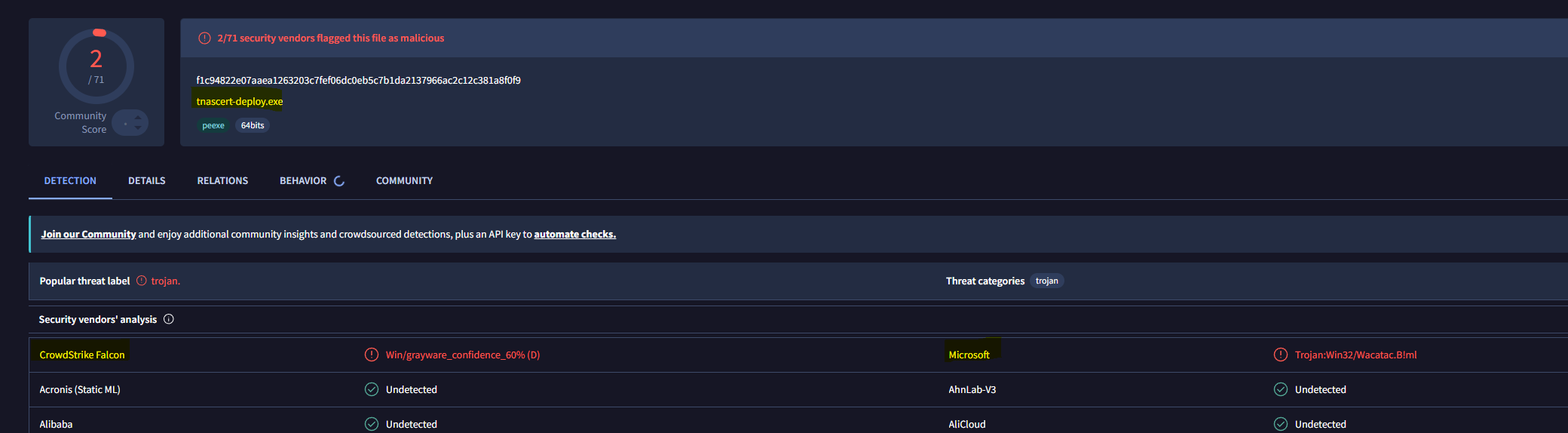
Are you guys aware, that VirusTotal is listing TNAScert 2.3 as a Trojan?
(Crowdstrike & Microsoft)
I’m the developer of tnascert-deploy. I just released 2.3 recently. It is a legitimate tool used to deploy TLS certificates to TruNAS systems. You can view all the source code at the tnascert-deploy source code. It is written in Go and it is my understanding that compiled Go programs frequently trigger false positives in security software.
@CryptoWizard would you be able to send me the details from your VirusTotal scan?
If anyone finds a bug or has any concern about the tool, please contact me on this forum and/or file an issue at the Github repository and I will work to address and fix the bug.
Check the Source: Ensure you downloaded the binary strictly from the Official
jrushford/tnascert-deploy GitHub Repository .
- Verify the Hash: Compare the SHA-256 hash of your downloaded file against the hash
provided in the release notes on GitHub.
- Inspect the Detections: Look closely at which engines flag it on VirusTotal . If
major vendors (like Microsoft, Kaspersky, or Bitdefender) mark it clean, but 1–3
obscure engines mark it as Malicious or Heuristic, it is safely a false positive.
- Compile from Source: If you want absolute security, bypass pre-compiled binaries
entirely. Download the source code from GitHub and build the Go binary yourself
locally
thanks
John Rushford
I don’t have any further details, apart from the screenshot. I don’t know if VirusTotal offers further info. I’ve never looked further.
I did assume it was a false positive.
I went ahead & successfully used Tnascert-deploy to deploy certs from SmallStep to TN & Portainer on TN.
Good to know Go triggers false positives.
Although I can code, I haven’t learned Go yet.
>Go compiles differently than languages like C or C++. It statically links the entire runtime and standard library into every executable
Seriously?
Something like .Net runtimes? Although .Net runtime not compiled into exes.
Form my Brave browser…
Primary Causes of False Positives
1. Unique Binary Structure and Runtime
Go compiles differently than languages like C or C++. It statically links the entire runtime and standard library into every executable. This results in a distinctive binary fingerprint that many antivirus engines do not frequently encounter in legitimate software.
Signature Overlap: Antivirus vendors often create signatures based on patterns found in malware. Since many malware authors now use Go, AV scanners may flag the Go runtime itself as suspicious, causing even a simple “Hello World” program to be detected as a trojan.