None of the ones available for public consumption are good for anything but regurgitating stuff you can’t trust. I doubt the private ones are much better.
In the future? We’ll see I guess.
None of the ones available for public consumption are good for anything but regurgitating stuff you can’t trust. I doubt the private ones are much better.
In the future? We’ll see I guess.
That sets your requirements to a micro-ATX board (or larger) with 4+ SATA ports (preferable 6-8, just in case…) and preferably two x8 PCIe slots. Last generation not required.
AsRock Rack E3C246D4U2-2T?
I orderd this one, as my cpu is AMD.
GIGABYTE MC12-LE0
Considering it has IPMI, that is an awesome price. Reminds me of the $50 mobo everyone used to recommend.
Good if you still found one for a reasonable price (it was a 50 € bargain last year, but prices went up when stock finally ran low). 
6 SATA. Get a x8x4x4 adapter to run a low profile dGPU and a pair of M.2 SSDs in the x16 slot, as the single on-board M.2 slot is x1 and strictly meant for the boot device.
It cost 250€… But I can install a HBA, if I am running out of SATA ports.
I will keep that in my mind. My sparkle arc a310 eco only uses x8.
Still a fair price for a genuine server board, the modern likes of which are 400-500 €.
But a that price level an E3C246D4U2-2T gets you 2 more SATA ports, 2 x4 M.2 slots on-board, x16/x8 + x0/x8 slots and 10GBase-T.
With a single x16 slot and a x8 dGPU, you’ll need a x8x8 riser and a bit of creativity with extension cables—and move your app pool to SATA SSDs.
So plan ahead to avoid headaches!
So I need a x8 for my future HBA. Gotcha.
This is already done. Mirror incoming as soon as the second SDD arrives.
Sounds good.
Okay, I’ll then switch to that one. It’s cheaper on eBay.
But these Xeons are still very pricey… even in used state.
Have all supported cpus on the ASRock support list full ECC support?
C246 supports ECC with Xeon E-2100/2200 and Core i3-8100/9100 CPUs (not i5 and higher). The only difference is that i3 support only up to 64 GB RAM while Xeon E go up to 128 GB (and can have more cores).
ASRock Rack E3C246D4U2-2T and Intel Xeon E-2236 ordered. GIGABYTE MC12-LE0 is canceled.
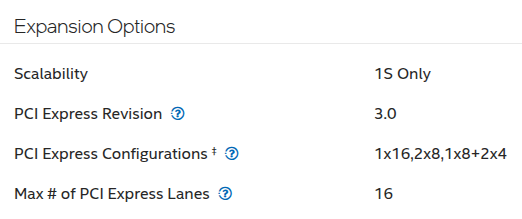
That motherboard supports xeons with integrated graphics, and the UHD Graphics P630 is capable of both transcoding and tonemapping in jellyfin, hence no need for that arc a310 unless you need to encode to hevc or av1.
All you need to do is enable multi monitor in bios and the P630 is available for passthrough to jellyfin.
You could swap that 2236 for a 2226G, and have 8 more pcie lanes free for other things, just a thought.
I feel better with HEVC and AV1 support.
I cannot see any differences.
I’m sorry! It took me a while to understand it. I could omit the dGPU and thus save x8.
But E-2226G is a six core CPU without HT.
Yeah, i was referring to the lanes the dgpu would free up, sorry, I could have worded that better.
Yes, you are indeed correct, and the E-2246G would be the nearest match. I looked too quick only judging by core count and tdp on intel ark.
I recently swapped out the hardware in my truenas box, going from the typical “ex-gaming pc to nas build” with an 11600k with uhd graphics 750 to a supermicro x11spi-tf and a xeon 6244 mostly for the option of going with lots and lots of cheap second hand ecc server ram and onboard 10GbE , and got an arc a310 for jellyfin, and it performs amazingly, but honestly the igpu wasn’t that far behind. Intel igpus are very performant in h.264 encoding, but fall flat on their face in hevc encoding.
Since you’ve made it clear that you’d rather use the a310, then that’s that, you’re set in regards to cpu.
Hello,
a few days have passed. Today I finally finished with my new server. The migration went smoothly. Thank you very much for your support and the helpful tips, both regarding TrueNAS and the hardware recommendations!
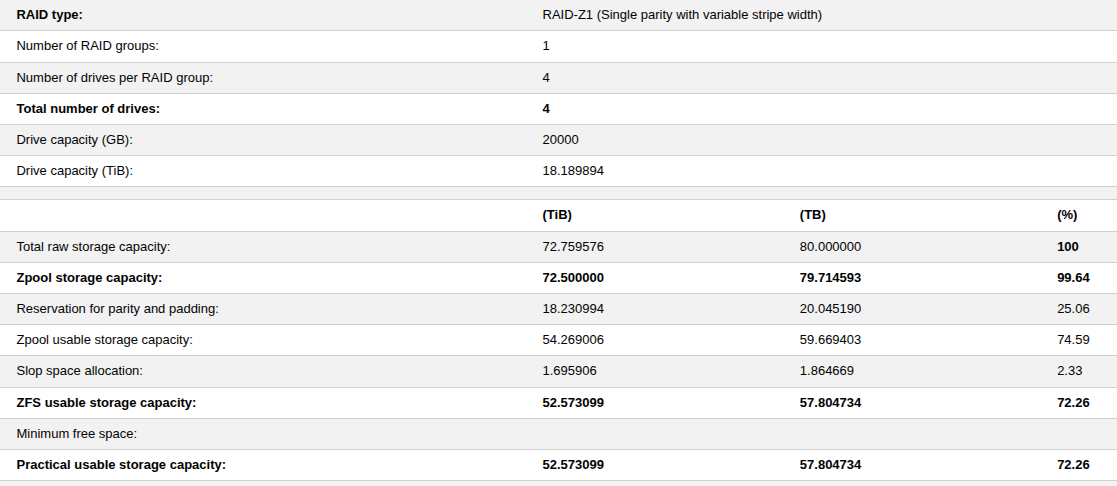
Initially, I had a 20 TB hard drive. When I upgraded the hardware for the server, I purchased three additional 20 TB hard drives. I created a RAIDZ1 with these and copied all the data from the first hard drive onto it. I then added the hard drive from which the data was copied to the array.
However, I am missing 4 TiB of storage space. The scrubbing runs until 9 pm.
truenas_admin@truenas[~]$ sudo zpool get all data2
NAME   PROPERTY                       VALUE                          SOURCE
data2  size                           72.8T                          -
data2  capacity                       34%                            -
data2  altroot                        /mnt                           local
data2  health                         ONLINE                         -
data2  guid                           2771083124053792770            -
data2  version                        -                              default
data2  bootfs                         -                              default
data2  delegation                     on                             default
data2  autoreplace                    off                            default
data2  cachefile                      /data/zfs/zpool.cache          local
data2  failmode                       continue                       local
data2  listsnapshots                  off                            default
data2  autoexpand                     on                             local
data2  dedupratio                     1.00x                          -
data2  free                           47.8T                          -
data2  allocated                      24.9T                          -
data2  readonly                       off                            -
data2  ashift                         12                             local
data2  comment                        -                              default
data2  expandsize                     -                              -
data2  freeing                        0                              -
data2  fragmentation                  0%                             -
data2  leaked                         0                              -
data2  multihost                      off                            default
data2  checkpoint                     -                              -
data2  load_guid                      13982868841672547457           -
data2  autotrim                       off                            default
data2  compatibility                  off                            default
data2  bcloneused                     0                              -
data2  bclonesaved                    0                              -
data2  bcloneratio                    1.00x                          -
data2  dedup_table_size               0                              -
data2  dedup_table_quota              auto                           default
data2  last_scrubbed_txg              0                              -
data2  feature@async_destroy          enabled                        local
data2  feature@empty_bpobj            active                         local
data2  feature@lz4_compress           active                         local
data2  feature@multi_vdev_crash_dump  enabled                        local
data2  feature@spacemap_histogram     active                         local
data2  feature@enabled_txg            active                         local
data2  feature@hole_birth             active                         local
data2  feature@extensible_dataset     active                         local
data2  feature@embedded_data          active                         local
data2  feature@bookmarks              enabled                        local
data2  feature@filesystem_limits      enabled                        local
data2  feature@large_blocks           active                         local
data2  feature@large_dnode            enabled                        local
data2  feature@sha512                 enabled                        local
data2  feature@skein                  enabled                        local
data2  feature@edonr                  enabled                        local
data2  feature@userobj_accounting     active                         local
data2  feature@encryption             active                         local
data2  feature@project_quota          active                         local
data2  feature@device_removal         enabled                        local
data2  feature@obsolete_counts        enabled                        local
data2  feature@zpool_checkpoint       enabled                        local
data2  feature@spacemap_v2            active                         local
data2  feature@allocation_classes     enabled                        local
data2  feature@resilver_defer         enabled                        local
data2  feature@bookmark_v2            enabled                        local
data2  feature@redaction_bookmarks    enabled                        local
data2  feature@redacted_datasets      enabled                        local
data2  feature@bookmark_written       enabled                        local
data2  feature@log_spacemap           active                         local
data2  feature@livelist               enabled                        local
data2  feature@device_rebuild         enabled                        local
data2  feature@zstd_compress          enabled                        local
data2  feature@draid                  enabled                        local
data2  feature@zilsaxattr             active                         local
data2  feature@head_errlog            active                         local
data2  feature@blake3                 enabled                        local
data2  feature@block_cloning          enabled                        local
data2  feature@vdev_zaps_v2           active                         local
data2  feature@redaction_list_spill   enabled                        local
data2  feature@raidz_expansion        active                         local
data2  feature@fast_dedup             enabled                        local
data2  feature@longname               enabled                        local
data2  feature@large_microzap         enabled                        local
pool: data2
 state: ONLINE
  scan: scrub in progress since Sun Aug  3 12:59:09 2025
        24.5T / 24.5T scanned, 21.7T / 24.5T issued at 925M/s
        0B repaired, 88.83% done, 00:51:38 to go
expand: expanded raidz1-0 copied 24.5T in 21:44:46, on Sun Aug  3 12:59:09 2025
config:

        NAME                                      STATE     READ WRITE CKSUM
        data2                                     ONLINE       0     0     0
          raidz1-0                                ONLINE       0     0     0
            c35f07e6-1a5d-492f-85c0-de75b033f213  ONLINE       0     0     0
            f066da66-8c78-4c82-9d22-b1889a91204f  ONLINE       0     0     0
            f025156c-fa3c-4530-8dc2-1a7eddd06689  ONLINE       0     0     0
            1ec673d8-190a-4132-8868-d1e5b4d10480  ONLINE       0     0     0
This motherboard seems to be praised at STH. The big negative is the 2 SATA ports. I’m not opposed to pairing this with an EPYC processor in a media server/NAS if I go down that route. I’m very new to this and I’m wondering which controller I can add to give me more SATA ports?
That would be a SAS HBA, taking the PCIe slot and adding power.
Fair if you need a lot of drives, not so good if you only need a few. In the latter case, choose a motherboard with enough SATA ports (Intel C or Z chipsets, 8; AMD B550, 6; AMD B650, 4; Atom C3000, up to 12).
This board without a chipset is a testimony that SATA if being phased out. It’s well suited for compute tasks, or for NVMe storage, not so much for HDD storage.
How much capacity do you need? And how much do you expect to need a few years for now?