
I am building a low-power embedded system that needs a lot of drives. Will an LSI 9400-16i (used with slow spinning rust so the bottlenecking I’m about to describe isn’t an issue) that has a physical PCIEx8 interface work with only two PCIE lanes? Due to PCIE bifurcation on the motherboard and limited PCIE lanes to the CPU I can only use 2x PCIE 3.0 lanes coming from a M.2 connector and converting that to the PCIEx8 connector. Has anyone tried this, or if you have one of these can you try it and let me know? Thanks!
For the 2 lanes verses more, that will only affect speed. Should not be a problem unless you intended to use a lot of SATA or SAS SSDs. Even then, they would work, just not as fast.
This was part of the reason for going to PCIe, verses the old parallel PCI, reduced lanes supplied to the card would still work. Unlike PCI 33Mhz/66Mhz 32bit/64bit, which made plugging in higher performance cards into less performing slots problematic, (it might work or not work).
However, you need to make sure of 2 more things:
- Cooling. LSI HBAs tend to run warm or even hot. Now to be fair, later generations like the 9400-16i will be on newer transistor nodes, thus should use less power. And generate less heat. But, cool the card / chip anyway.
- Power. You need to make sure your M.2 to PCIe x8 adapter has enough power. The tiny M.2 slot likely won’t supply enough power all by it’s self. This M.2 to PCIe adapter should have an external power supply connection. (Well, external to the M.2 slot, but from the internal power supply. Like MOLEX 5v/12v…)
Yes, I have considered those things. I do need external 12V power for the LSI card and will need additional forced air cooling. I know the old cards could run at x4 PCIE lanes but I don’t think I ever saw anyone trying to run at x2 (reasonably so). My question is - will the LSI 9400-16i actually drop down to x2 PCIE lanes or does it require more to operate?
https://docs.broadcom.com/doc/BC00-0459EN
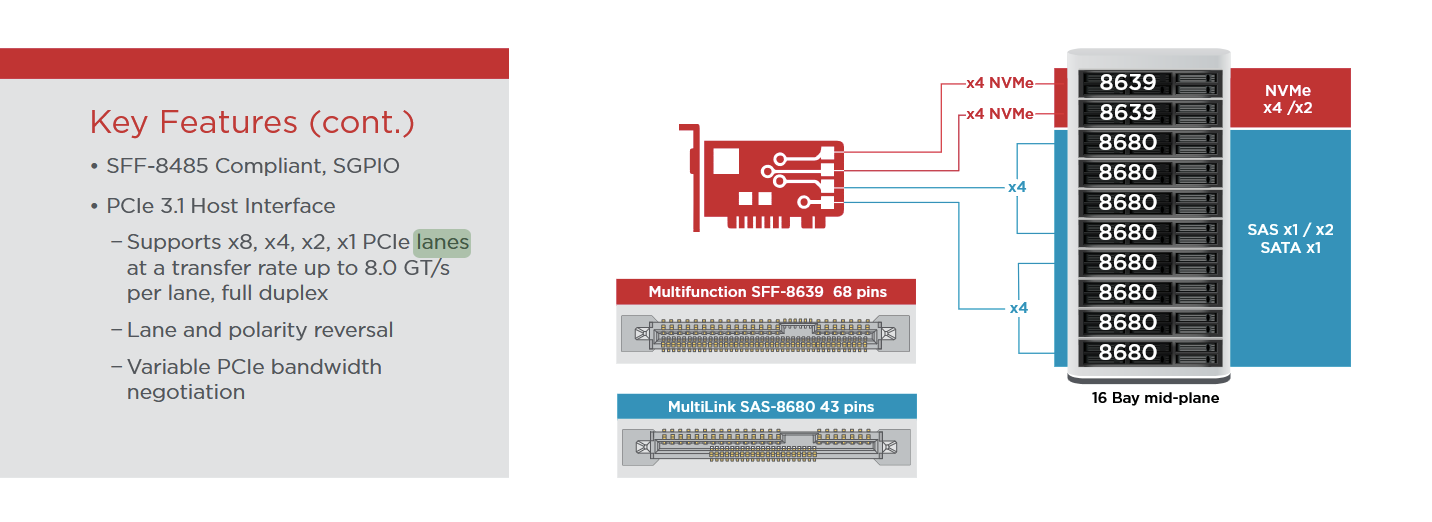
Should function if you can get heat & power sorted as Arwen previously stated.
Ah, beautiful. Thank you!
Kind of a contradiction in terms…
Have you considered building with an Atom C3758 (A2SDi-H-TF or -8C-LN4F), which supports 12 SATA without any additional HBA?
Edit Or a good old X10SDV (Xeon D-1500), which sips power at idle and has at least a full PCIe 3.0 x16 slot (or a pair of x8 if you go for a Flex-ATX board) for your HBA.
The PCIe standard require all compliant devices to work with only one lane. Devices may aggregate multiple lanes in order to scale bandwidth.
Do you need all 16 ports? There are 9-port M.2 SATA controller cards like this one:

The conservative-minded here (wrt. NAS matters, nothing political) will find this RTL9101 even more dubious than running a PCIe 4.0 HBA from a PCIe 3.0x2 M.2 slot.
I tried PHDK PH519. Connected 8 SATA HDDs. Unfortunately, running `fdisk -l` couldn’t even detect the file systems without ATA read errors. Several minutes later whole controller fell of the PCIe bus and could no longer be visible. The controller exposes something like 30 SATA endpoints even though max 9 are physically connected. With that amount of attention to detail it’s not surprising that the device does not work properly.
I can’t find a specific example; but I swear I’ve seen devices that go against the standard & require multiple lanes. Especially in older enterprise world
Yes, as usual, there are offenders out there that don’t conform to the standard. I’ve heard of/seen them too but the specific examples escape me as well.