
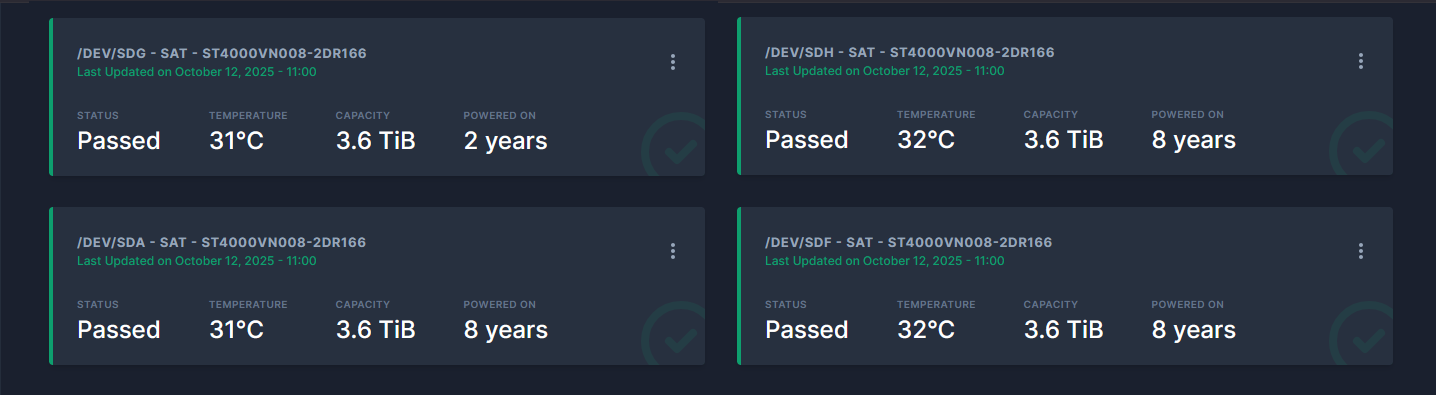
I’ve had a good run old of these drives out of the 24 drives I have only had 5 die.
Welcome to the TrueNAS Forums.
That is impressive. Maybe they will run to 10 years?
My advice, if they are in a resilient pool, let them run if the capacity if still fine. Why waste money and then see how long they can really last. Maybe write a success letter to Seagate (Marketing) and praising them for such high quality work. Maybe they will send you some free drives. Hey, it is nice to dream once in a while.
Don’t swap disks just because they’re old, if they still work and are adequate for your current needs.
But do have a replacement plan ready, in the same way you should have a replacement plan for a 3 month old device.
 Pretty impressive! I think I’ve got a few HDDs that are even older tucked away somewhere. They haven’t been online eight years consecutively mind you. — just transferred to old PCs, then retired to a drawer, and left to gather dust ever since.
I’ve been pretty lucky over my 40 years on this planet (minus childhood) — I’ve built plenty of PCs and gone through countless hard drives, and if memory serves me well, I’ve only ever had one truly fail. That dreaded clicking sound… like the actuator arms were playing football  on the platters.
You should definitely push those drives to their limits, but keep some backups handy. It’d be a real shame if all those 8-year-old drives gave up at once!
-T
Not sure if all 24 drives mentioned in the opening post are actually running, but replacing some of the older 4 TB disks with newer, higher-capacity models could make sense — not just for capacity, but also for reducing the total number of drives.
That would mean lower power consumption, less vibration, less noise, and less physical space needed.
I have some HGST 6TB drives with 9+ continuous 24/7 operational years with no errors. Some have had over 1.6PB read from them but low 300+TB written to them. I have no plans to replace them from age as I see no reason and they are in a system with less than 40% total space used so they don’t need to be bigger.
Since they are in a full server chassis, I would likely see little real power change by reducing the numbers. By reducing numbers I may also have to reduce vdevs which I would prefer to not do. I also have some higher capacity 10TB enterprise drives online 24/7 for just over 5 years and as soon as the warranty hit 4 years or expired after 5 they started generating sector errors. I did have 2 fail at 3 years which were replaced. To me the higher capacity drives are not very robust or at least not as robust as 6 and 8 TB drives.
The case I fitted these dives into is a Chenbro RM41416, 16 working drives the rest kept as spares if and when a drive died, still got 3 unopened 4TB from the same batch.
I will be migrating the whole setup onto newer larger drives in the near future, RAIDZ1 was ok for the 4TB drives but will reconfigure to RAIDZ2 due to going to 18TB drives. Its funny but just this one pool is near the same size as as the entire storage space as the 16 drives.
Times have changed
Doesn’t those drives age with time; though unopened?
I always used to wonder, does it make sense to buy the spare from the same batch and hold - or to accumulate spares gradually (like 1 every 2nd year).
Just would like to know the opinion/learnings of all who might have tried or thought similar strategies.