TrueNAS Tech Talk returns from hiatus with a guest star and an exciting new software build! TrueNAS user and Community member Joel May, software engineer by day, has compiled and released the first ARM developer builds for TrueNAS Fangtooth (25.04)! Find out about what enticed Joel to build TrueNAS for a completely different platform, the challenges he had along the way, and speculate on the future of ARM in the datacenter - and then, jump to the download links below to get your own (early) build of TrueNAS for ARM processors, test it out, and report how well it works for you!
Turns out they also had smaller ARM-based NAS’ over there, with everything from 2-16 bays for 3.5” drives. The 2 bay unit reminds me vaguely of the old AirPort Extreme, the rack mount units more strongly of the Apple SAN gear, likely because of the satin aluminum look.
The front views of the rack mountable units give me pause, ie I’m presently skeptical that hard drives in there are getting properly bathed with cooling air due to the small size of vents but then again, UBNT may have decided like another well-known OEM that operating HDDs at 55*C is in spec and therefore fine.
The cooling fan openings in the rear suggest to me that these units are going to run either hot or loud under load.
Will have a look around and see if anyone has actually reviewed these units. Adopting ARM processors across the board of its entire NAS portfolio is a pretty bold move!
…which seems to be paying off as the UNAS 4 and Pro4 are both sold out on the European store. (Or supply was really low to begin with.)
Incidentally, ARM processors ensure that units are locked to the proprietary OS (“firmware”).
Interestingly, youtube reviewers seem to be presently embargoed from showing the guts of the enas. See here, for example.
The device is very Apple in that the guts are not to be exposed, everything is proprietary and slides in from the outside. Even SSD cache is based on proprietary NVME sticks that slide in via the rear. Meanwhile there is a magnetic snap on front cover that can power up give you a light show, control the fans, etc.
The PSUs would likely give @greco a heart attack but at least there are two of them. Also, no PCIe expansion. The unit either meets your needs as designed, or it doesn’t.
The video above has some interesting insights into how Ubiquitis vision for a file server UI diverges from TrueNAS, RouterOs, etc. Because they control both hardware and software, it’s a lot easier for them to visualize things. Reminds me of QNAP, Synology, ReadyNAS for similar reasons.
The UBNT UI remains consistent with the usual set of icons on the left of the screen, so UBNT fans will feel right at home, I guess.
To me, this is not a product aimed at serious enterprise storage. Rather, it’s aimed at the prosumer NAS market that Apple abandoned, ie devices that perform well, are pretty, and can be sold for $$$.
[quote=“Constantin, post:3, topic:50785”]
introductory cost of $4000.
[/quote]
Ouch! I didn’t see a spec for the NAS power consumption, they were all related to the drives. I guess I could say it is 100 watts if the drives can consume 450 watts from a 550 watt power supply, after all you know people selling stuff put the specs to the theoretical maximum. But $4,000 is way too much, maybe it is the 64GB RAM that inflated the price
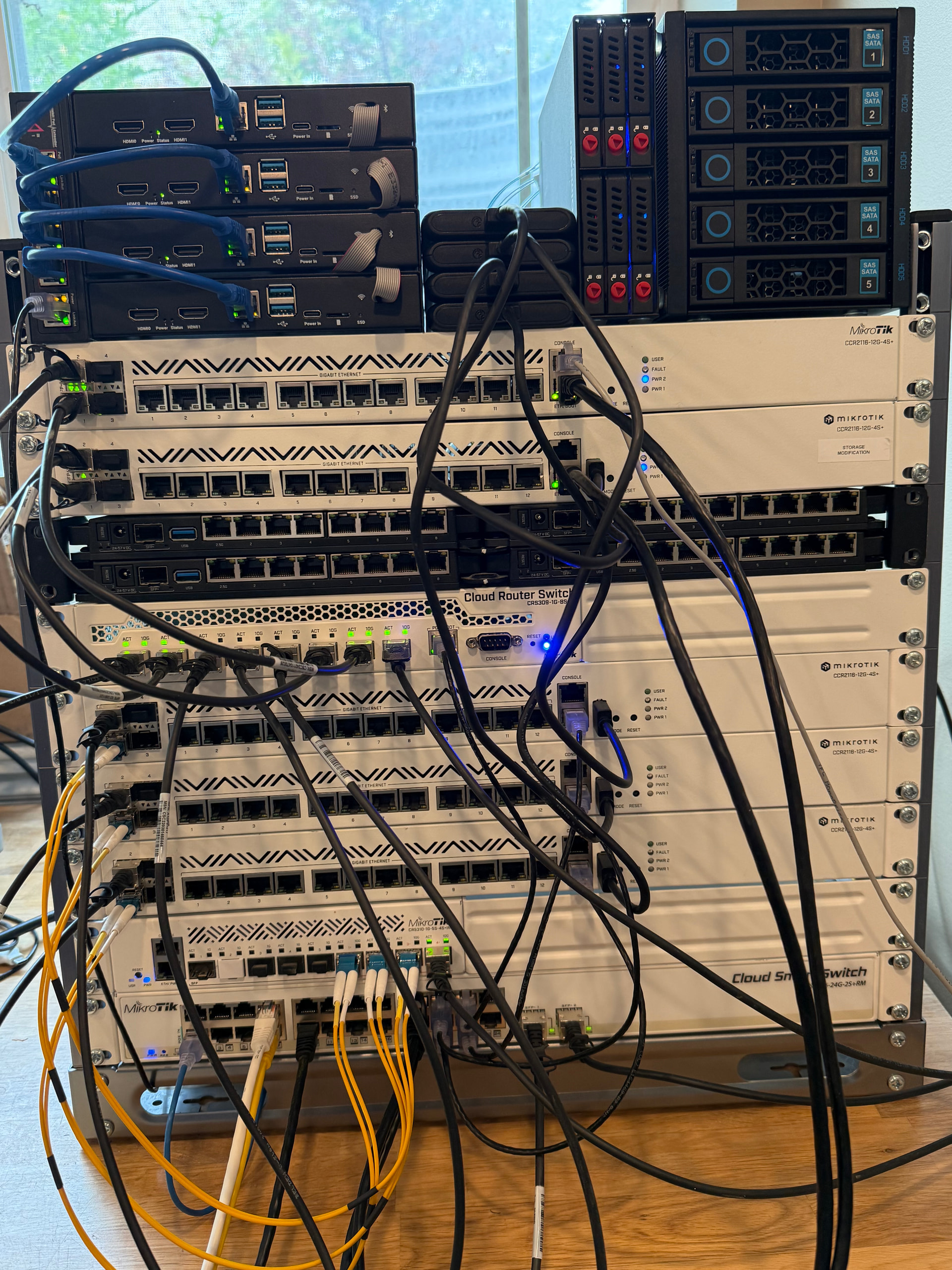
I’ve mentioned this over on the other TrueNAS ARM64 thread, but I’ve gotten Proxmox and TrueNAS VM’s working on MikroTik CCR2116’s and RDS2216, and I am now looking at getting TrueNAS to run bare metal on both (primarily the RDS2216). Both have 16 2-GHz cores and loads of ports.
This is the stack of 2216’s in the lab before being moved to the server room.
The bottom three of these are running Ceph with 1TB SSD’s inside them on the NVMe M.2 slot.
The top two have 8-port SATA adapters in the M.2 slot, each handling 4-5 HDD’s and 3-4 SSD’s. They have TrueNAS as a VM, each with 8GB of RAM, sharing a mirrored array of HDD’s and SSD’s for meta/small files. They replaced my 2012 Mac Pros, and consume 50-70w at load. Compare that to the Pro’s 200W idle (before drives & load). Sure, I could probably get more RAM cache performance out of the Macs, but these arrays aren’t heavily hit.
The RDS2216 goes for about $1600-1800, depending on where you get it. Much more affordable than UI’s solution, esp. for small installations and home labs. You get 20 NVME U.2 slots up front, 2 M.2 SATA slots inside, 2x100G, 4x25G, 4x10G SFP, 2x10GBE on the back, and 32GB of RAM (not great, but not horrible for the price).
I’m at a point where I have a custom kernel and drivers that will boot the routers into Proxmox without touching the onboard NAND, and leveraging @Joel0’s work I expect to have that same kernel + driver stack land me into a modified TrueNAS SCALE installation on an onboard disk (USB, SATA, or NMVe).