The big difference between the 2-core D-1508 and the D -1537 is cores and clock speed. There is a 10W TDP difference as well but unless you use all the cores all the time, I doubt the heat nor the power will be all that different.
I found my D-1537 board to be VERY finicky re memory. As in find the EXACT spec down to the last digit in the SKU from the approved hardware list or the system would only recognize two out of four DIMMs.
I did not have any luck running the ZoneMinder or whatever CCTV package in a jail. Running blueiris in a windows VM was unsuccessful as well. It could very likely be my inexperience that was the issue. But I got the sense that the 1.7GHz cores made it too easy to miss an event due to being overtaxed.
Heat wise, I replaced the CPU HX with a Cu version and an active cooler. I also added a bunch of fans and some tape to direct air flow, etc. See here. This was not necessary, it was just a design goal to have the system run relatively quietly but cool to maximize lifespan. Without scripts, the CPU rarely cracked 40* C, the HDDs hardly ever got above 30* C.
No issues with heat, and I subsequently adopted @stux script which makes the fans a lot quieter. FAN1-4 on the motherboard is dedicated to the CPU and rear case fans, FANA runs the three fans cooling the HDDs, FANB powers the little fan I strapped to the HBA.
The primary reason I advocate the -2C- version of this board for file server use is price and clock speed (which helps SMB) in my pokey 1VDEV system with a little sVDEV it gets up to 400MB/s sustained write speeds. So the slower clock of the D1537 doesn’t seem to be the limiting factor re: transfers.
Maybe I will find more uses for the cores when I have to move to SCALE. in the meantime, they lie fallow.
I’m less certain this could be the case, but i don’t have a hardware background. What other things were you running that taxed the processor so much. What was happening that led you to expect you were missing events?
TIL. I hadn’t realized SMB performance dependended on single-thread clock speeds.
Does this mean that the -2C- model has an edge for handling 10Gbe transfers? Or is the Xeon D architecture better suited for that?
TDP is irrelevant; what matters most is idle power.
X10SR7 takes UDIMM in limited capcity, has 14 SAS+SATA ports and PCIe slots for adding a SFP+ NIC, and high clocks for serving SMB to few clients .
X10SDV takes RDIMM in possibly large capacity, can have high cores for multiple VMS/apps. Mini-ITX boards are limited to 6 SATA port and a single x16 slot for adding either a HBA, a SFP+ NIC or 4*NVMe (unless you mess with bifurcating risers/cables…); Flex-ATX boards have two x8 slots for both a HBA and SFP+, and may already come with a HBA and/or SFP+ but these -7TPnF boards are the most sought after and carry a matching price tag.
For a basic SMB NAS with limited memory needs but 8-14 drives (no less, no more), a X10SR+CPU kit under $200 may well have an edge over a $500 X10SDV-2C-7TP4F.
I’m referring to ZoneMinder and BlueIris re: events, ie they couldn’t do what they were supposed. For ZoneMinder it was hard to see what the cause could be since ZoneMinder runs natively on TrueNAS and nothing obvious stood out. It would miss people walking right through a frame.
Despite dedicating 4 (?) cores, the VM for BlueIris would operate much of its time in the 100% CPU used state meaning it couldn’t handle the image processing. That in turn meant it couldn’t capture simple stuff like movement or even record everything in SD.
I have a dedicated computer now for BlueIris and the program uses very little CPU and a lot of RAM. So it could very well be the ongoing software development and better settings in the meantime that allow my rig to record in HD and note when people / animals / etc enter a frame.
SMB is single threaded per user so if you have a large number of users, more cores are your friend. For SOHO file server-only setups, few cores are usually needed. But even my pokey 1,7GHz CPU is not the bottleneck re: a single VDEV system with a sVDEV. It’s the pool that limits my sustained large-file writes to about 400MB/s.
The main reason I love the D15xx series of CPUs is that they have a lot of PCIe lanes that allow the board designer to have a lot of fun re: expansion cards, NVME, mSATA, etc. unlike the challenges by the same designers when dealing with the atom series and its very limited PCIe lanes.
I wanted a board that could handle a lot of potential tasks and which had room for future expansion, if I needed it. Size was not a factor since my a76 case can swallow anything. With onboard HBA and SFP+ those expansion slots can go to something something, whatever it will be.
Coincidentally, STH has just posted a review of an Atom P5000 board, namely A3SSV-16C-SPLN10F:
25 GbE onboard—sweet, but you’re not going to saturate that with spinning rust.
Then the I/O is seriously underwhelming: 6 SATA ports… and merely SATA-2 at that—good enough for HDDs, not for SSDs. Various M.2 slots, all of which are PCIe 2.0 x2—boot only, no L2ARC or SLOG here. PCIe 3.0 x8 and x4 slots—to add a much required HBA for use as a NAS.
tl;dr This last gen Flex-ATX Atom board has less I/O than a mini-ITX X10SDV, and much of that I/O is of a lower spec than on the X10SDV. It is not suitable for all-NVMe arrays, and cannot make full use of its 25 GbE link with spinning rust. Stay with A2SDi or X10SDV.
It’s quite bizarre, really. SATA 3 Gb/s ports were phased out from the standard PCH in 2014/2015, with Haswell-EP and Skylake, respectively.
I get reducing the I/O a bit, since these are going to end up mostly inside routers, switches and similar things, not as much inside servers. I would get a single PCIe 2.0 lane for the BMC. The only other consumers I can imagine for those lanes are gigabit NICs, i.e. the I210 and I350, but that doesn’t make it less insane to me.
The D15xx series of Xeon chips gave designers a cornucopia of PCIe lanes, such that using anything less than a flex ATX board will likely waste some of them. Depending on the use case, that’s entirely OK.
I’m happy with my pokey D1537, it will not break speed records but the board can address 22 SATA drives at once, hold a decent SLOG, has two PCIe 3.0x8 slots, on board SFP+, etc. The newer boards seem to be focused on other markets, some of it flash.
Atom boards definitely have their use cases but for NAS’ they tend to feature too few PCIe lanes to handle a decent number of drives, a SFP+ connection, etc. For the small cost delta relative to the D15xx series I don’t get the benefit but I see a lot of compromises being made (for NAS applications).
Bottom line, the market in general is shifting away from storage outside of data centers (who frequently design their own motherboards). HDDs have a lifespan associated with them no different than wired headphones did for the iPhone. At some point, they will be designed out of the product.
While iXSystems seems to have had a good corporate relationship with Asrock Rack, a lot of folk who bought asrock found the post sale support to be virtually nonexistent. A few of them got help via social media but at best it was super uneven.
Contrast that with my excellent experience with iXSystems or SuperMicro. The former with the c2570 board in the miniXL (replaced multiple times due to avr54 bug) and the latter with some post sale questions. SuperMicro and iXSystems will always get my business first as a result.
That said, if the board is only $150-$300, then a failure won’t sting as much.
Fair enough. I’m not going to pretend to prefer Asrock over Supermicro. Actually if I had to pick a platform it’s Cisco UCS
This is like the old here’s 3 things, pick 2.
Price
Speed
Support
Pick two.
For the price here? We’re talking about a fantastic server platform for less than the cost of a consumer platform at this power target, I haven’t seen a better deal
This would be a very sad shift. Although Apple is already soldering things in place I have a hard time imagining stand-alone drives would be available only to datacenters.
I wonder if we’d ever get to a point where we’d see open source or independent motherboard design for this application area. or maybe there already is?
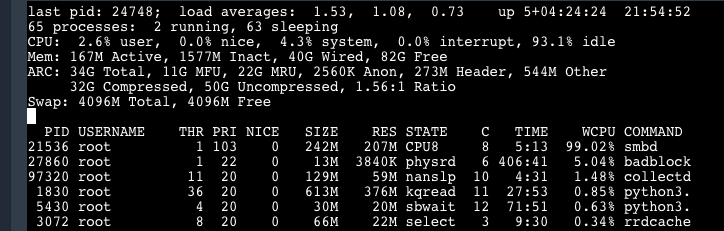
Here’s an example of the SMB process being tongue-tied by the sVDEV and slow CPU combination. Running a rsync backup task and a single core is getting smushed by SMB.
It’s just a reflection on why I recommend the -2C- version of this board for SOHO use. The extra 500 MHz clock speed gives the SMB user an extra 25% performance at a lower price point than my 8 core D-1537. Does it make a huge difference? No.
But why spend 2x the cost of the -2C- if the cores are on the one hand 93% idle and on the other hand maxed out for singular processes? The same limits were hit re VM use or ZoneMinder - the slow clock speed maxed out the CPU repeatedly.
wonderfully illustrated. I suppose I am over eager to get started and jumped at the chance to get “the good one”. In my case the price differential is not as big. But the outcome is still 25% more cost for ~25% lower clock speed.