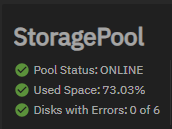
What seemed like a sound financial decision in the days before the AI apocalypse is now leaving me questioning my sanity. One “renewed” 18TB Seagate Ironwolf (purchased from Amazon) kicked the bucket in a little under two years. The replacement I purchased from eBay, which I only just received yesterday, is throwing this not-so-subtle error:
SMART overall-health self-assessment test result: FAILED! Drive failure expected in less than 24 hours. SAVE ALL DATA.
Not sure at this point if I should abandon my mirror config and redo my entire NAS in some form of lower capacity RAID. This would not be so horrible if 18TB hard drives were still in the $200-300 range. Mistakes were made.
Even more curious is this.
Device is: Not in smartctl database
I did some light Googling and found an article involving a scammers and Seagate Ironwolf and Exos drives. So I don’t know if the lesson is “be careful where you buy your hard drives” or “don’t spend over $500 on a hard drive.”
I went against the grain… I bought my second-hand disks from private sellers (with a good reputation, ofc) and I didn’t have had any nasty surprises.
What I hadn’t considered was that, once the 2~3 years of use I’d expected for them (or at least, the time I’d filled them up), the price for TB could increase so much (both for new or used).
i really think that travel along that route will cost you more than replace your disk. For me i was considering 4TB size, i need 6… price changed from 100~120 each to +200
You didn’t do anything outslandish to yourself, the AI craze did it.
Hopefully you have some buyer protecting and can get a refund for the lemon from eBay.
Which leaves you looking for a 18+ TB at acceptable price. Good luck chasing that!
I followed the same path as @oxyde and replaced all 10-12 TB in my initial NAS builds by second hand 16 and 20 TB bought from STH forum (as a sizeable batch to initiate the process), local small ads and the eBay store of a local refurbisher. In the process I have reduced the number of drives but bought more than I need to have cold spares at hand (burnt-in for about 5 years by the previous owners )… and sold my old drives on local small ads (so reaping back some benefit from inflated prices).
This is good news. You can get your money back since you used Ebay. Have you contacted the seller to let them try to fix the issue?, you might just want your money back as well. If yes and they are not willing to play, File a dispute with Ebay. And do all the communications via Ebay messaging to maintain a paper trail.
There are reputable resellers that stand by a real no kidding warranty, no questions asked and they ship you a replacement drive. My point here, only buy from a place with a good reputation. Some people are honest as in the case of @oxyde and he was lucky enough to purchased good used drives. And when it comes to the cost of these larger capacity drives, well new and used are going to be expensive.
Completely agree, this is how I do it as well.
When you think about rebuilding your server, how much storage do you “really need”? Not what is nice to have. I only ask this because I am probably the minority here with a huge capacity of 8TB total capacity but only use 5TB of storage, the majority of that being 3 to 6 months of backups of a few computers. I “need” just over 1TB of storage to save all my data minus the backups. So, if you are running a media server and have 500 movies online, which you rarely watch, then consider archiving the content and leave the videos that you watch a few times a year.
This does not fix your hard drive issue but it may allow you to bring your setup to a more reasonable size that you can afford, at least until drive prices start dropping again.
In the past, I tried to avoid bringing up their name because I didn’t want to compete with others for their limited inventory. It doesn’t matter anymore, since the bubble affected the prices from all vendors.
I have been happy with the manufacturer recertified[1] drives that I purchase from them. I consider these as reliable as new drives, but with a nice discount.
Hot take: I trust manufacturer recertified drives more than “new” drives, since they receive extra human attention and testing before being sold, as well as the manufacturer putting their reputation on the line.
@rambro1stbud I purchased 8 Seagate Exos[2] (manufacturer recertified) from Server Part Deals over two years ago and have not had a single error on any of them yet. Not scientific, but you can take this anecdote for what it’s worth.
Not to be confused with refurbished or renewed drives. ↩︎
Yeah I was double protected with the 30-day money back guarantee and one year extended warranty. In the end, I won’t get screwed, and I have a 20TB from Seagate on the way. They don’t even sell 18TB Ironwolfs anymore. Which means I’ll eventually have to replace the OTHER 18TB with a 20TB at some point down the line.
That could be true. However, I don’t need to trust drives. I trust ZFS.
The IMHO problem with these recertified drives is that they only come with a 2-year warranty but are not that much cheaper.
When it comes to electronics, I always assume to run it as long as the warranty is. Everything above is just lucky extra, I don’t count on.
So a $2000 laptop with a 5-year warranty is in my books cheaper than a $1000 laptop with a 2-year warranty. First one costs me $400 a year, second one $500.
Not necessarily true. Re-certified drives can come with 5 yr warranties and generally much lower cost than new out of the box drives. While warranties are nice, it’s consistency in reliability that really counts. The warranty doesn’t mean much if the device performs as expected past the warranty period. They are a nice safety net should something go wrong. It’s not worth buying something that consistently fails regardless of warranty. i.e., 8/10 drives fail after 2 years of 5 yr warranty versus 8/10 drives functions past the 5 yr warranty period. It’s all based risk acceptance.
That would make no economical sense for the vendor. The only place, where I can see what you describe, is with Arctic products. They offer 6y just like Noctua but IMHO count on customers not actually create an RMA for their almost 6y old fan, that costed 5$. Otherwise that company could file for chapter 11
And since you can’t know the failure rate of harddrives beforehand, the only thing you can count on is warranty. I got my refurbished 20TB Seagate Exos for 350$ and was pretty annoyed that I did not get normal ones for 400$. The seller not taking them back was IMHO a rip off. Now I have 8 drives with no warranty, instead of 8 drives with 2y warranty left. If none of them fail in the next two years, that bet has payed off.
…Consider we’re starting to see manufacturers fail to honour any kind of warranty in the world of storage & memory, I don’t know which kind of warranty I’d prefer least between the two.
Multiple examples of, at best, folks getting their original payment refunded; which is likely 50% or less than the items now cost thanks to AI price increases. *Depending on when item originally purchased
Maybe I’d prefer the seller’s warranty if they actually give me a functional replacement drive instead of half of what it’d now cost to buy a replacement.
For what it’s worth and knock on wood, I’ve had nothing but good luck with Amazon factory re certified 22TB Seagate EXOS drives having purchased ten of them installed in a Dell PowerEdge R740 TrueNAS system and two QNAP NAS systems before the prices went sky high.
I guess it’s the luck of the draw and I am still knocking on wood.
I had a string of drives with errors I had to repeatedly RMA for six months from a reputable reseller of refurbished drives. They always came through with a replacement, but I suggest always keeping an extra or two you can deploy while they process and send out a new one. This also gives you time to properly test the drive before putting it into service.
Now, the same drives are up from $259 to $629 which is absolutely insane. My drives have been stable for a while now all through the AI price jumps which is poetry, but I do have one that’s showing a few more CRC errors each time my report gets emailed. Normally I’d RMA the drive immediately, but I’ve refrained since it’s not a major concern. Will they ship me a new drive and honor the warranty? I think they will. That’s the #1 reason you should always buy from good reputable dealers. The 5-year warranty has saved me more time than I can count and the up-fron cost of a few spares keeps me spinning.


 )… and sold my old drives on local small ads (so reaping back some benefit from inflated prices).