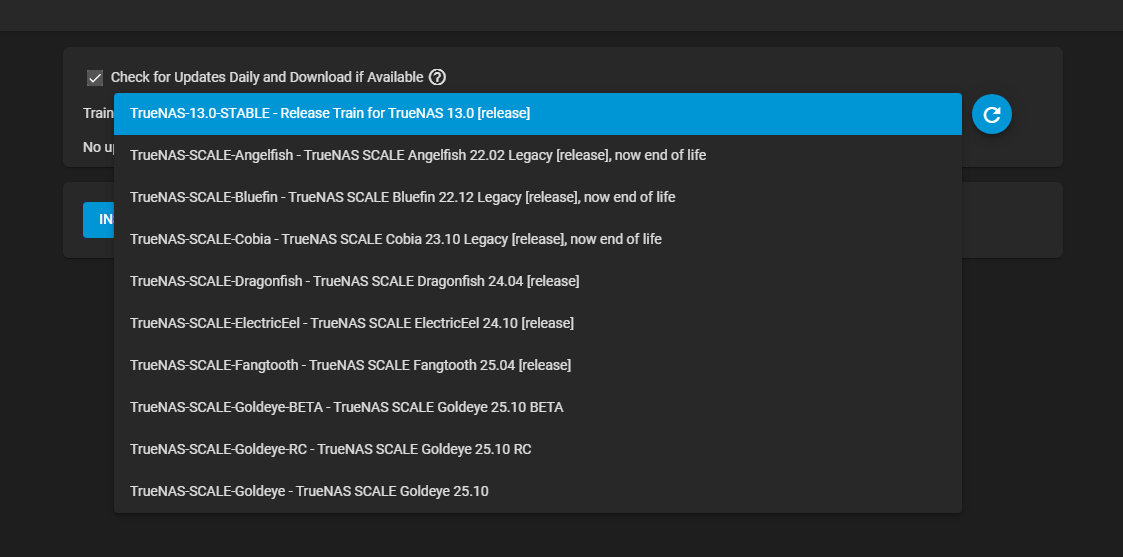
I need some help / advice I have a TrueNas Mini R that is my file server. I noticed the other day that for some reason it was not getting updates anymore. So when I checked the update page I got the following below.
So after some digging I found out that my verison of Core is EOL . So the question is what do I do now? just keep running what I have as its been fine for years or do I upgrade and hope that in teh upgrade process I don’t lost all my data.
You won’t loose data during an update since the update process doesn’t touch data pools, only the boot pool. If you’re on 13.0.X you can manually download the udpate file for truenas 13.3 which is the last bsd based release of truenas. Or you follow the recommended update path listed in the truenas documentation and upgrad/sidegrade/migrate (whatever you want to call it) to truenas CE 25.10.7
Another option would be to save your config file, install a new clean boot ssd, install truenas CE 25.10.7 and import your config file.
Edit:
you would only encounter issues with your storage pool if they are using geli encryption which is not supported by truenas CE
Thanks for the info I didn’t use encryption on any of the drives as I didn’t know how to when I setup the Mini a few years ago as winning it in a contest was my first experince with TrueNas.
I will try to find this upgrade documention and see how hard it is to do and go from there.
I guess that the OP does not have jails, so he has no reason to go for 13.3… unless he wants to stay on FreeBSD as base OS and migrate to FreeCORE.
13.0-U6.8 is actually a later release than 13.3-U1.2.
Thanks for the info everyone. Even though the Mini R is not facing the internet to access the files on it I still think it would be a good idea to update it. That way I can keep learning TrueNas and its current verison and not try to learn something that is outdated. If that makes sense.
I just need to figure out what SSD I need to order to replace the boot drive as with a quick search I read its worth keeping the old drive just in case and installing the new verison on a new drive and then import everything in.
I am just worried about data lose, I do have backups if needed just don’t want to deal with a restore.
Thanks @etorix yeah I was planning on getting a Samsung EVO drive if it fits. I need to take the top off the server and see the M.2 size first before I get anything.
I am just worried about reinstalling the OS and not being able to figure out how to import everything back. Really don’t want to lose 20tb + worth of data.
Export your config with the secret seed. Do it right now.
The config can be imported into a fresh install to restore your settings, services, shares, and tasks.
Data pools are independent of the NAS or OS. You can take a ZFS pool from FreeBSD and import it into Debian, then from Debian to openSUSE, then from openSUSE to FreeBSD, then from FreeBSD to Arch Linux. As long as the version of ZFS on the system is recent enough to support all enabled/active pool features, the pool can be imported.
@StarTrek133 I think you need to be a bit more specific on what your concerns are. The linked Preparing to Migrate post should cover most of the issues that is in post 4.
Did you read the online documentation to see if any issues apply? You probably want to end up installing CE 25.10.7 as that release is General Availability on the Software Status page and considered well tested. You would go to check for Updates once installed and make sure your system is set to General Availability for the Update Train. That keeps you from seeing any updates that are not considered GA quality.
Your pool should be found and import by itself. You may have to make some changes for SMB shares, depending on if you were doing something in the past like sharing a Root (Parent) data set instead of have a Child data set and sharing that. That would be moving files to a new child data set set up for sharing and following the online docs. The Root and truenas_admin users don’t have SMB sharing by default.
And… ?
You’re not finding documentation about getting back access to your data because “it just works”. Changing train or installing a new version to a (new) boot device does not touch data. You said you already have backups—good
Thanks @winnielinnie for the info , but I was either told or saw someone where that I can’t upgrade from Core to Scale like that as it doesn’t work. Now I am new to TrueNas so I could be wrong.
That might’ve been my post here: So, the day has arrived - #7 by Samuel_Tai . It depends on how complex your existing CORE config is. Mine was pretty complex as I’d upgraded it several times starting from FreeNAS 9.3 starting in 2015, with lots of tunables, SMB auxiliary parameters, bhyve VMs running GRUB, multi-app jails, etc. I knew a straight upgrade would likely not work due to all this accumulated complexity.
If your config is a lot more vanilla, with only a couple of shares, a straight upgrade is much likelier to go more smoothly.